
welcome, i’m matt!
I believe the old model of the distant, neutral therapist fails the people who need therapy most. I’m not just here to witness; I’m here to actively guide, repair, and feel with you as you find your own transformative power. I believe that bringing my full, human self into the room with skillful restraint is how we practice healthy attachment, connection, and intimacy. I share my story not to take up space, but to show you how I hold it.
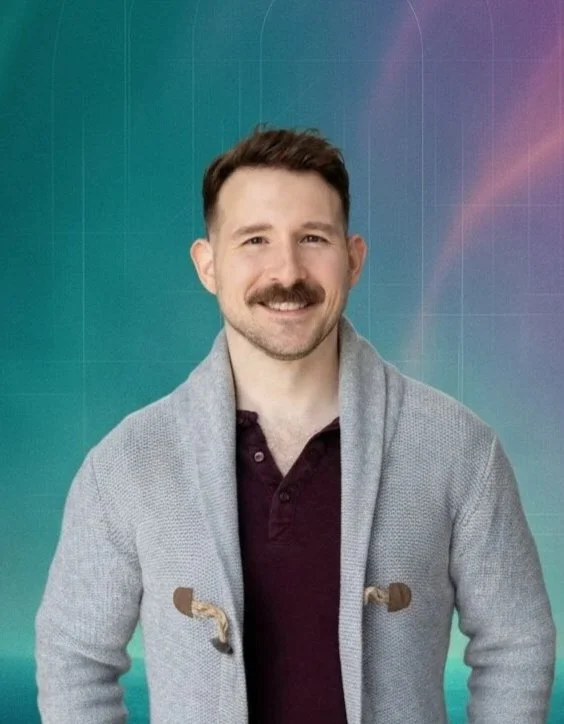
about me
The queer, neurodivergent son of a Spanish-speaking immigrant mother and a first-generation entrepreneurial father, I grew up reading people, code-switching, and climbing for survival. Those skills carried me into a decade of transformational corporate leadership. My strategic brain sharpened, but so did my fear.
Along the way, I learned the hidden cost of trauma-driven high achievement and neurotype masking. I felt the unnerving hollowness of building a life that seems “right” on the surface but lacks a foundation of soulful and sober intimacy. I had friends, partners, success—but something was missing. I outmaneuvered every executive coach and therapist I hired; not even my Clinical Psychology master’s program taught me how to unlock the answer. It wasn’t until I dedicated myself to the structural depth of Internal Family Systems (IFS) and group work that I found the clever map to Self I was missing.
I’ve dedicated the last five years to rebalancing my ambition with meaningful connection, inside and out. My friendships, my family relationships, and—most importantly—my relationship to my own parts have clearer boundaries, warmer presence, and less performance. I didn’t have to choose between success and soul. I successfully shifted from disconnected achievement to embodied wholeness, and now I’m here to help you do the same.
my approach
structural & integrative
My work is highly strategic and integrative. I draw from multiple modalities to customize a plan for your specific system, but my foundation is Internal Family Systems (IFS). I dedicated myself to rigorous training with the IFS Institute because I believe this model offers sustainable transformation, not just a patch. It doesn’t just resolve the current crisis; it installs a new operating system that allows you to solve future problems on your own.
why traditional therapy fails us
Standard behavioral therapies often try to train you out of a behavior. They teach you to catch a “negative” thought, challenge it, and stop it. This focus on symptom management is appealing to the parts of us in a rush for relief—we just want the pain to stop. That desire is understandable. But it’s like taking the batteries out of a smoke alarm because the noise is annoying. Sure, the noise stops. But you didn’t find out why it was going off in the first place. And worse: now you’ve disabled your warning system. Your house is quieter, but it is actually more deeply broken. IFS starts with curiosity: "Why is the alarm ringing?"
transformation over suppression
We operate from the assumption that every behavior—even the ones you hate—is trying to solve a problem for you. If we simply force a behavior to stop without meeting the core need it was feeding, your system will just find a new (and often louder) way to scream. A Concrete Example: Take a behavior like compulsive sex or relentless workaholism.
The Old Model says: "This is a dysfunction. We need to restrict it, manage the urge, and use discipline to stop."
Our Approach asks: "What is this behavior doing for you? Is it numbing a deep loneliness? Is it the only place you feel powerful? Is it a frantic attempt to feel connection?"
If we pile on shame and demand willpower, the pressure builds. You might stop the workaholism, only to start overeating or slipping into depression. That is why we don't shame the behavior; we honor its true intent. It’s like a finger trap: the harder you pull away, the tighter it gets. You have to lean in to find the release. By finding the "why," we heal the underlying wound. When we do that, the compulsion doesn't just get suppressed—it transforms. The energy that was driving the addiction is liberated into something sustainable—like true intimacy, creative drive, or grounded passion.
Crucially, this leaves you with more than just a healed wound. It leaves you with a permanent skill: the ability to relate to your own internal system with curiosity rather than shame, preparing you to handle future challenges long after our work is done.
resonance as a tool
Finally, the most important tool I bring isn't a theory—it's my own nervous system. In high-stakes therapy, you don't just need a listener; you need an anchor. Because I have done my own deep work to unburden my system, I am able to hold a specific frequency of "Self-energy"—calm, curiosity, compassion, and confidence—even when your system is in chaos. Think of it like a tuning fork. When you are overwhelmed by anxiety, shame, or rage, I don't just watch you drown. I maintain a steady, grounded resonance that your system can feel. By "lending" you my Self-energy, I create a safety field that allows your own protective parts to relax, unblend, and trust the process. I don't just teach you about Self-leadership; I model it in real-time, giving your system a template for what it feels like to be truly led from within.
strategic intimacy & collective healing
This resonance is vital when we add more people to the room. In relationships and groups, our "parts" often trigger each other in lightning-fast loops: one person's shutdown triggers the other's panic; one person's rage triggers the group's shame. I act as both the Anchor and the Strategic Interpreter. First, I use my own resonance to stabilize the room, acting as a circuit breaker for those reactive loops. Once the safety field is established, I help each individual turn inward and take responsibility for their system’s responses while translating the "protective" behaviors (shutting down, yelling, fixing) into language others can actually hear. Whether you are a couple, a family, a polycule, or a group member, this process allows us to move from "fighting about the dishes" to understanding—and healing—the deep systemic dance happening underneath.
my credentials & training
While my approach is relational and intuitive, it is grounded in rigorous professional training and evidence-based structures.
Registered Associate Marriage and Family Therapist AMFT143779
Supervised by Neil Schierholz PsyD, Licensed Psychologist PSY25154
education
University of California, Berkeley - Berkeley, California
BA Sociology
Antioch University - Los Angeles, California
MA Clinical Psychology
additional trainings
Internal Family Systems Level 1 Training from the IFS Institute
Internal Family Systems Circle Training from the IFS Institute
LGBTQIA+ Advanced Community Training, including specialized courses on consentual non-monogamy, HIV/AIDS, neurodivergence, and domestic violence from the Los Angeles LGBT Center
Trauma-Focused Cognitive Behavioral Therapy from the Medical University of South Carolina
Crisis Intervention and Intervening After Trauma Exposure from Antioch University
Law and Ethics from Aspira Continuing Education
match with me
who i work best with
I am a direct, insightful therapist who works best with clients ready to value healing over comfort.
This approach is likely a fit if:
You are a strategic thinker who would appreciate a neurodivergent gamer’s mind, someone who sees patterns others miss, loves solving puzzles, and believes that even deep work should have moments of laughter and play.
You are tired of “blank slate” therapists and want an active, engaged guide you can’t outmaneuver.
You are ready to move beyond venting about your week and get into deep, structural change.
You value directness, challenge, and a space that can hold your full complexity, including your shadow side.
This approach is likely NOT a fit if:
You are looking for a passive listener just to validate your week.
You want a quick-fix behavioral hack rather than deep systemic work.
You need your therapist to be a “neutral observer” who never shares their own resonance.
You are actively struggling with extreme substance use or a life-threatening crisis.
ready to take the next step?
If my approach resonates, I invite you to take the next step. Let’s see if we're a good fit to do this work together by hopping on a video call and getting to know each other.